If you have a flat roof with an EPDM membrane and you’re dealing with a leak, there’s a better-than-average chance the seam is where the problem started. Seam failures are the leading cause of EPDM roof leaks on both commercial and residential properties across Asheville and the broader Western North Carolina region — and our mountain climate is a significant reason why.

EPDM roof seam repair is something property owners and facility managers here deal with regularly. Understanding why seams fail in the first place, how to spot them before they cause interior damage, and what professional repair actually involves helps you act faster and spend smarter when a problem develops.
For a full picture of how EPDM seam failures fit into the broader range of flat roof issues, the complete EPDM roof repair guide for Asheville properties covers all failure types and repair methods across the system.
Why EPDM Seams Fail More Than Any Other Part of the Roof
To understand why EPDM roof seam repair comes up so often, you have to understand how EPDM seams are made in the first place. EPDM is a rubber membrane — it doesn’t fuse to itself the way TPO does under heat. Instead, EPDM seams are bonded with contact cement or seam tape, creating an adhesive connection between overlapping membrane edges.
The result: you can have a field membrane that looks and performs perfectly well while the seams connecting individual rolls are quietly separating. Water finds those separations long before a visual inspection would catch them. EPDM roof seam repair is often a reactive fix to a problem that had been developing for months or years before it became a leak.
This is fundamentally different from TPO, where heat-welded seams create a molecular bond that’s actually stronger than the membrane on either side of it. EPDM’s adhesive seam system is a known tradeoff — the material performs exceptionally well in temperature extremes, but seams require more attention than the field membrane. That’s not a criticism of EPDM; it’s a characteristic to manage.
How Asheville’s Climate Accelerates EPDM Seam Failure
Western North Carolina’s mountain climate is harder on EPDM seams than most regions in the Southeast. Three factors drive this.
Freeze-Thaw Cycling
Asheville typically experiences 50 to 70 freeze-thaw events per year — nights that drop below 32°F followed by daytime temperatures above it. Each cycle causes the EPDM membrane to contract slightly in the cold and expand slightly in the warmth. Individually, those movements are small. Cumulatively, over hundreds of cycles across a multi-year period, that movement fatigues adhesive bonds at seams and terminations.

An EPDM seam that was installed correctly but is 10 years into Asheville’s freeze-thaw cycles has experienced significant cumulative stress that a similar seam on a roof in Charleston or Wilmington has not. This is one reason that EPDM roof seam repair frequency is higher in mountain climates than our coastal counterparts see with the same material and installation methods.
Humidity and Temperature Swings Within a Single Day
Asheville summers bring relative humidity regularly in the 80 to 90% range. On a flat EPDM roof, that humidity level combined with direct sun exposure creates surface temperatures that can swing 50 to 60 degrees between early morning and mid-afternoon on clear summer days. That’s a significant thermal shock cycle that occurs on top of the seasonal freeze-thaw pattern.
Seam tape edges are particularly vulnerable to this daily temperature swing. The tape itself handles it reasonably well, but the transition zone where the tape edge meets the open membrane is a stress concentration point where peeling tends to initiate.
UV Exposure at Elevation
Asheville’s elevation — around 2,100 feet — means measurably stronger UV radiation than lower-elevation locations in the Carolinas. EPDM itself is UV-resistant, which is one of the material’s genuine strengths. But the contact cement and seam adhesives used in EPDM seam construction are more vulnerable to UV degradation than the membrane. Over time, UV exposure at seam edges contributes to adhesive breakdown — particularly on seams near roof edges that don’t have parapet protection from direct sun.
The flat roof membrane shrinkage and splitting guide for Asheville covers how these climate stresses interact with membrane aging in greater detail.
Identifying EPDM Seam Failure Before It Becomes a Leak
The best EPDM roof seam repair is the one that happens before water gets in. Here’s what to look for and feel for during routine inspections.
The Hand-Probe Test
Walking seam lines and running your hand along each seam edge tells you more than a visual inspection alone. A seam that looks fine from five feet away can have a 1/4-inch lift at its edge that you’ll clearly feel with your hand. Any lifting, bubbling, or looseness along a seam edge is worth flagging — even if no water is entering yet.
Do this systematically. Work a section at a time, probing both the top seam edge and the lower edge of each overlap. Pay particular attention to inside corners, roof edges, and anywhere the membrane changes direction — these high-movement zones see more stress than straight field seams.
Visual Indicators
Visible seam tape shrinkage at lap edges — where the tape has pulled back from its original position, leaving a slight ridge — is an early indicator. Seam edges that have developed a whitish or dried-out appearance in the adhesive zone suggest the cement has reached the end of its bonding effectiveness. Small wrinkles running parallel to a seam rather than perpendicular to it indicate the membrane is beginning to pull.
On black EPDM membranes, moisture tracking marks — lighter streaks extending from seam locations across the membrane surface — often appear after rain events and indicate water is migrating under the seam edge before draining or evaporating.
Interior Signs That Point Toward Seam Failure
Water stains on interior ceiling tiles that appear or expand after rain events are an obvious sign. Less obvious: staining that appears in a linear pattern rather than a circular one often corresponds to water tracking along a seam beneath the membrane. When a ceiling stain is elongated rather than roughly circular, that pattern is worth noting when explaining the damage to a roofing contractor — it helps narrow the investigation.
The commercial roof leak detection guide explains the professional investigation process for locating EPDM seam failures that aren’t immediately visible during surface inspection.
The Professional EPDM Roof Seam Repair Process
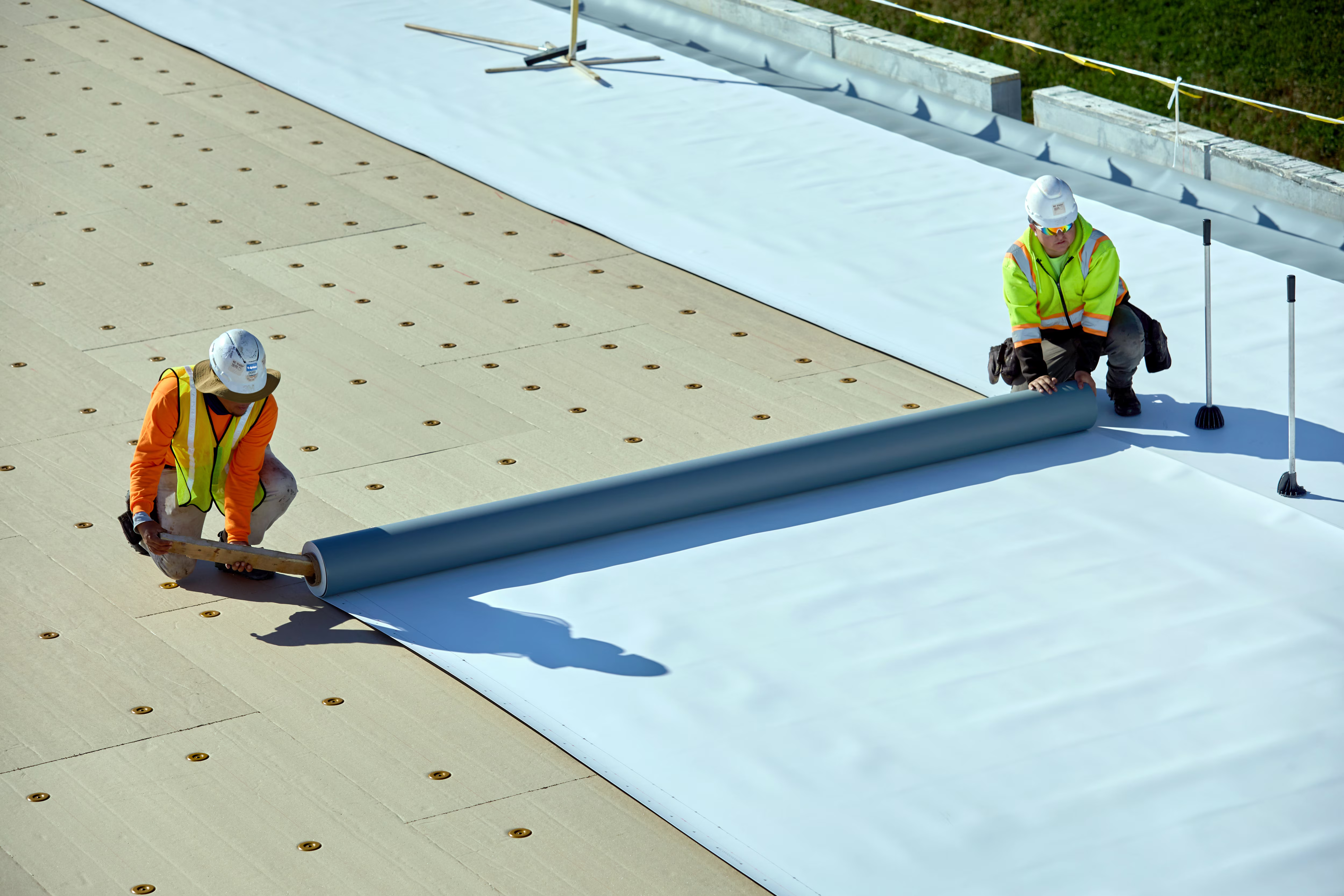
EPDM roof seam repair done correctly follows a specific sequence. Skipping or rushing any step produces a repair that fails before the surrounding membrane does.
Step 1: Probe the Full Seam Length
The visible separation or suspected failure point is rarely the full extent of the seam problem. A professional EPDM roof seam repair starts by probing the entire seam length in both directions from the obvious damage to find where solid adhesion ends. The repair must extend well past the separation boundary — at least 6 inches beyond the last point of confirmed good bond — to ensure the repair anchors into sound material.
Step 2: Clean the Repair Area
Both the existing membrane surface and the underside of the lifting seam edge must be cleaned with EPDM-specific membrane cleaner. This removes dirt, oxidation, and any residue from the original adhesive that could interfere with the new bond. On older membranes, surface oxidation is significant — the chalky layer that forms on aged EPDM won’t accept adhesive reliably without thorough cleaning.
Step 3: Apply Primer
EPDM primer is applied to both surfaces — the membrane and the underside of the lifting seam edge — and allowed to flash off (dry to tacky). Primer opens the EPDM surface for proper adhesive penetration. Skipping primer on EPDM roof seam repair is a common shortcut that significantly reduces bond durability.
Step 4: Apply Contact Cement or Seam Tape and Bond
Contact cement goes onto both primed surfaces and is allowed to reach the correct tack point — not wet, not fully dry. Timing this stage correctly is a skill that comes from experience; under-tacky cement produces a weak bond, over-cured cement bonds immediately, but with reduced strength. The seam edge is then carefully rolled into contact, starting from one end and working toward the other to eliminate air pockets, and immediately rolled with a hand roller to ensure full contact pressure across the bonded surface.
Step 5: Apply Lap Sealant
The finished seam edge gets a bead of EPDM-compatible lap sealant along its full length, tooled to fully contact both the seam edge and the underlying membrane. Lap sealant is not a substitute for the adhesive bond beneath it — it’s the finished seam edge protection that prevents water from wicking under the tape or cement boundary.
Step 6: Inspect and Test
A completed EPDM roof seam repair gets re-probed after the adhesive cures to verify no areas are lifted during bonding. Any section that doesn’t feel solidly bonded gets additional adhesive and re-rolling. On commercial properties where the repair area is large or the leak history is significant, some contractors use electronic leak detection to verify that the repaired seam is water-tight before calling the work complete.
Can You DIY EPDM Roof Seam Repair?
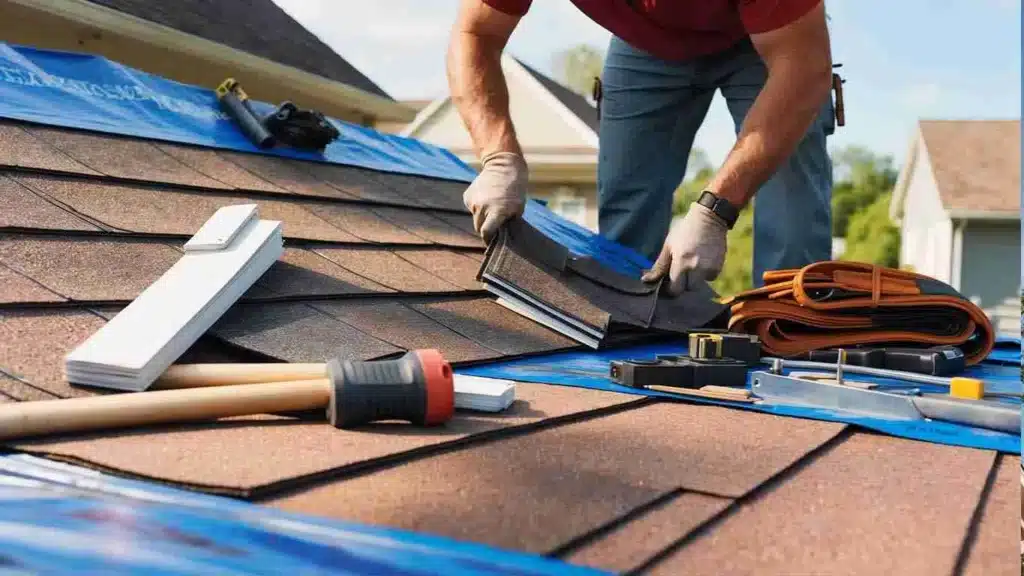
EPDM is more accessible to DIY repair than TPO — no specialized welding equipment is required. But seam repair is the most technically demanding of all EPDM repair types, and it’s where DIY approaches are most likely to fall short.
The challenge isn’t the physical effort. It’s the material knowledge: identifying the full extent of the separation rather than just the visible section, using EPDM-specific products rather than generic rubber adhesives, getting the adhesive tack timing right, and applying consistent roller pressure across the full bonded area. Each of these variables affects repair longevity. Getting one of them wrong produces an EPDM roof seam repair that holds through summer and fails when the first freeze-thaw cycle puts stress on the new bond.
When EPDM Roof Seam Repair Isn’t Enough
Some EPDM seam situations are beyond the point where repair is the economical choice. The indicators that point toward section replacement or full system replacement:
Multiple seam failures in different locations found during the same inspection suggest the adhesive across the whole roof has reached the end of life — not just in the areas that have failed, but across sections that haven’t failed yet. Repairing three seams when the entire field bonding is degrading buys limited time.
Moisture testing that reveals saturated insulation beneath seam failure locations means the water infiltration has already reached the substrate. An EPDM roof seam repair over wet insulation addresses the membrane entry point but not the underlying damage. The wet insulation continues to degrade the roof system from beneath and drives new failures.
A system older than 20 to 25 years with recurring seam failures across its service history has likely provided most of its useful life. The conversation shifts from repair to replacement planning.
The roof repair versus replacement decision guide for Asheville properties works through this analysis in detail and helps property owners understand when repair investment stops making economic sense.
For commercial buildings specifically, seasonal maintenance plans for Asheville businesses can catch developing seam failures before they reach this point — preventing the repeat-repair cycle that ends in premature replacement.
Frequently Asked Questions
How long does a professional EPDM roof seam repair last?
A properly executed EPDM roof seam repair on a system with remaining useful life should hold for many years — often the remaining service life of the surrounding membrane. Repairs that fail within a season or two almost always trace back to incomplete surface prep, incorrect adhesive materials, or a seam separation that extended further than the repair covered. When a seam repair doesn’t hold, the right next step is a broader assessment rather than a repeat patch in the same area.
How do I know if my EPDM seam failure caused insulation damage?
You can’t determine insulation saturation from a visual inspection of the membrane surface. Professional moisture scanning — using infrared or electronic detection equipment — is the only reliable way to assess whether water infiltration has reached the insulation layer. If your building has had an active leak for more than a few weeks before being addressed, moisture testing during the repair assessment is worth requesting.
Is EPDM roof seam repair covered by homeowners’ insurance?
Standard homeowners’ policies cover sudden damage from storms but exclude gradual deterioration. A seam that fails due to age-related adhesive breakdown is typically not a covered claim. A seam damaged by a fallen tree limb or displaced by a wind event often is. After any storm, photograph damage before making temporary repairs. Our insurance claim documentation guide for Asheville homeowners covers what insurers need to see.
Get Your EPDM Seams Inspected Before the Next Rain
EPDM roof seam repair is most straightforward — and least expensive — when it’s caught before water has been tracking under the membrane for weeks. A seam inspection costs nothing; a saturated insulation replacement costs significantly more than the seam repair would have.
Lane Roofing and Restoration provides free flat roof assessments for Asheville commercial and residential properties. We’ll probe your seams, check your flashings, and give you an honest read on where the system stands and what it needs.
Call 828-490-1830 or reach out through our contact page to schedule your free assessment.