When something goes wrong with a commercial flat roof in Asheville, business owners face decisions that residential homeowners rarely encounter. The stakes are different you’re protecting inventory, equipment, employees, and customers. The wrong material choice or a delayed repair can shut down operations, void warranties, or create liability exposure.

Here in Western North Carolina, commercial flat roofing carries its own set of challenges. Our mountain climate swings from humid summers pushing 90 degrees to winter ice storms that test every seam and membrane in a system. Asheville sees roughly 47 inches of rain annually, much of it hitting commercial flat roofs all at once during summer thunderstorm season. Without proper slope and drainage, that water has nowhere to go — and sitting water is the number one enemy of every commercial flat roofing material on the market.
This guide walks through the five main commercial flat roofing systems used on Asheville-area buildings, explains how each one holds up in our climate, and helps you understand whether repair or full replacement makes more sense for your situation. If you’re already dealing with active leaks, our commercial roof leak repair services are available to Asheville businesses throughout Buncombe County and the surrounding region.
Understanding Commercial Flat Roofing Systems
The term “flat roof” is a bit misleading. No commercial flat roof is perfectly flat — they’re built with a slight pitch (typically 1/4 inch per foot minimum) to move water toward drains or scuppers. When that drainage fails or the membrane deteriorates, problems follow quickly.
Commercial flat roofing materials differ from residential sloped roofs in two critical ways. First, they rely on a continuous waterproof membrane rather than overlapping materials that shed water by gravity. Second, they’re almost always under more mechanical stress — HVAC equipment, foot traffic from maintenance crews, and roof-mounted signage all create puncture and wear risks that sloped residential roofs rarely face.
The five primary commercial flat roofing materials used in Asheville are TPO, EPDM (rubber), PVC, built-up roofing (BUR), and modified bitumen. Each has strengths, weaknesses, and specific repair approaches. Understanding the differences will help you have a more informed conversation with your contractor — and protect yourself from recommendations that prioritize contractor convenience over your building’s actual needs.
For a broader look at how commercial systems work in our specific climate, the commercial roofing systems guide covers Lane Roofing’s full approach to Asheville business properties.
TPO (Thermoplastic Polyolefin) Roofing
TPO has become the most widely installed commercial flat roofing material in the country over the past decade, and for good reason. It offers a strong combination of energy efficiency, durability, and cost-effectiveness that suits a wide range of Asheville commercial properties.

System Characteristics and Typical Lifespan
TPO is a single-ply membrane that comes in rolls, typically 45 to 80 mils thick (a “mil” is one-thousandth of an inch). Thicker membranes cost more but offer better puncture resistance and longevity. A properly installed 60-mil TPO system on an Asheville commercial building should last 15 to 20 years with routine maintenance.
Common Repair Needs and Techniques
Most TPO failures in Asheville commercial properties trace back to three sources: seam separation, punctures from foot traffic or falling debris, and membrane deterioration around penetrations like HVAC curbs, vents, and drains.
The commercial flat roofing guide for Asheville businesses covers TPO drainage challenges specific to our region in greater detail.
Best Applications for Asheville Commercial Properties
TPO works particularly well on large, relatively simple roof planes — retail buildings, warehouses, medical offices, and industrial facilities in areas like South Asheville or the Swannanoa Valley. Its reflective surface is especially valuable on buildings where air conditioning costs are a concern during the summer months.
For Asheville businesses in historic districts, TPO may not be appropriate where visible roof surfaces affect architectural character, but for most utilitarian commercial applications, it’s one of the most practical and cost-effective choices available.
EPDM (Rubber) Roofing
EPDM — ethylene propylene diene monomer — is the black rubber membrane that’s been a commercial flat roofing material staple since the 1960s. It has an impressive track record for longevity and performs particularly well in regions with significant temperature swings. That description fits Asheville’s mountain climate well.
Durability in Temperature Extremes
EPDM’s most significant advantage is its flexibility across a wide temperature range. The material remains pliable and functional from well below freezing to extreme summer heat without becoming brittle or prone to cracking. For Asheville commercial properties at higher elevations — think properties in the Weaverville area or along Tunnel Road where temperature variations are more pronounced — this flexibility is genuinely valuable.
A properly installed EPDM system typically lasts 20 to 30 years. The material itself is highly resistant to UV radiation and ozone, two factors that degrade many commercial flat roofing materials over time. It handles ponding water reasonably well compared to some alternatives, which matters because flat roofs in Asheville inevitably experience some temporary water accumulation during heavy summer storms.
Repair Methods
EPDM repairs use three primary techniques depending on the nature and location of the damage. Small punctures or tears in field areas can often be repaired with EPDM-compatible adhesive tape and liquid rubber sealant. Larger damage areas typically require cut patches bonded with contact cement or specially formulated EPDM adhesive. Seam failures — the most common EPDM repair need — are addressed with lap sealant and re-bonding with EPDM primer and adhesive.
Cost-Effectiveness for Various Building Types
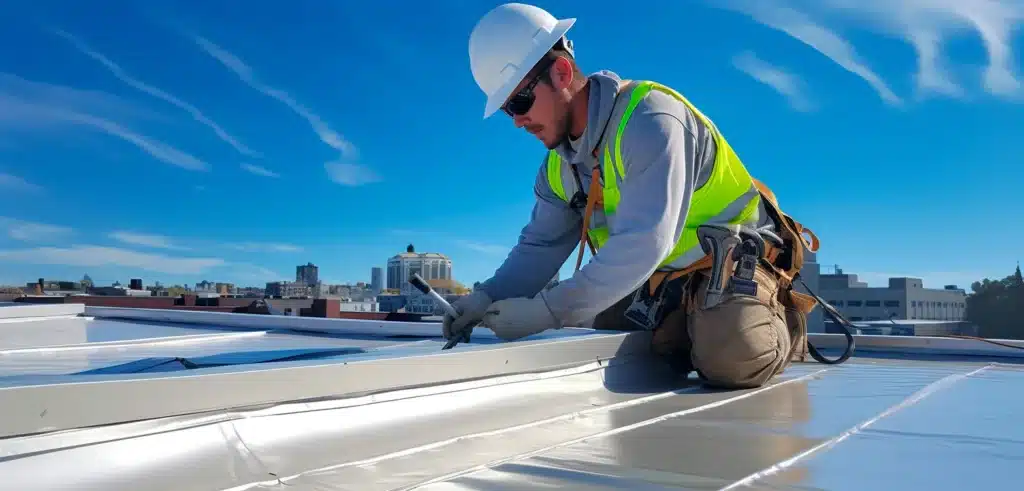
EPDM typically costs less per square foot installed than TPO or PVC, making it an attractive choice for budget-conscious projects or large roof areas. It’s particularly common on industrial facilities, storage buildings, and older commercial structures throughout Western NC, where the primary goal is reliable waterproofing without premium pricing.
For businesses weighing EPDM versus TPO, the energy cost difference from TPO’s reflective surface can offset some of the price gap over a 10 to 15-year period — though the math depends on your building’s cooling load and local energy rates.
Our EPDM repair guide for commercial properties in Western North Carolina covers the specific failure patterns we see most often on Asheville-area buildings.
PVC Commercial Roofing
PVC (polyvinyl chloride) commercial flat roofing materials are the premium single-ply option in the commercial flat roofing market. It shares some characteristics with TPO — both are white, both are heat-welded, and both offer good energy efficiency — but PVC has distinct advantages in certain situations that can justify its higher cost.
Chemical Resistance Properties
The primary application where PVC outperforms other commercial flat roofing materials is where chemical exposure is a concern. Restaurants, food processing facilities, and industrial buildings often have grease, oils, or chemical-laden exhaust hitting the roof surface. PVC is resistant to these substances in a way that TPO and EPDM are not.
If you’re operating a restaurant in downtown Asheville or Biltmore Village and your exhaust vents discharge directly onto the roof, grease contamination is a real issue. TPO and EPDM membranes exposed to cooking grease over time will degrade and fail prematurely. PVC holds up significantly better in these environments. The restaurant metal roofing guide touches on this issue from a different material perspective.
Premium Pricing Justification
PVC typically runs 20 to 40% more than comparable TPO installations. For a standard commercial building without chemical exposure concerns, that premium is hard to justify. But for food service, industrial, or specialty applications where alternative materials would fail early, PVC often delivers a better cost-per-year calculation over the life of the roof.
Repair Procedures and Longevity
PVC repairs follow the same basic approach as TPO — heat-welded patches for field damage, re-welded seams for separation, and liquid flashing around penetrations. One advantage of PVC is that it’s generally easier to achieve a strong field weld repair because the material is more forgiving of temperature variation during the welding process.
A well-maintained PVC commercial roof can last 20 to 30 years. The material does become more brittle over time as plasticizers migrate out of the membrane, which is why PVC roofs in their later years become more prone to cracking in cold weather. Periodic inspections in the fall before Asheville winters arrive are particularly valuable for aging PVC systems.
Built-Up Roofing (BUR) and Modified Bitumen
Before single-ply membranes dominated the commercial flat roofing materials, built-up roofing was the standard. Many Asheville commercial buildings — particularly older structures downtown and throughout the River Arts District — still have BUR or modified bitumen systems in place.

Traditional Multi-Layer Systems
Built-up roofing is exactly what the name suggests: multiple layers (typically three to five) of roofing felt alternated with hot-mopped asphalt or cold adhesive, then topped with a gravel surface or mineral cap sheet. The redundancy of multiple layers is BUR’s biggest strength — a single-layer failure doesn’t immediately mean a leak because other layers are still providing protection.
Repair Challenges and Opportunities
Repairing BUR is more labor-intensive than patching a single-ply membrane. Finding the source of a leak can be genuinely difficult because water can travel between layers before it penetrates into the building. The commercial roof leak detection guide covers the investigation process in detail.
When These Systems Still Make Sense
BUR and modified bitumen remain good choices in specific situations. If an Asheville building already has a BUR system in good underlying condition, replacing it with a single-ply membrane may require more substrate preparation and expense than simply adding a modified bitumen recover layer. BUR also performs well on roofs with heavy foot traffic or where hail impact resistance is important.
Asheville Climate Considerations for Commercial Flat Roofing Materials
Our mountain climate creates conditions that don’t appear in national roofing specifications. Understanding these factors helps explain why locally-informed installation and material selection matter for Asheville commercial properties.
Freeze-Thaw Cycling
Asheville’s winters typically bring multiple freeze-thaw cycles each season — temperatures that dip below freezing at night and climb above it during the day. For commercial flat roofing, this creates two problems. First, any water that has penetrated seams or membrane failures will expand as it freezes, widening existing damage. Second, the contraction and expansion stress membrane attachment points and seams with each cycle.
TPO and EPDM handle this cycling reasonably well, given their flexibility. PVC becomes more vulnerable to cracking in sustained cold, and BUR systems can experience alligatoring (surface cracking) in the asphalt layers if they’re aging. Membrane shrinkage and seam separation are the most common issues we see on Asheville commercial roofs after particularly cold winters.
Summer UV and Humidity
Western North Carolina summers bring UV radiation levels that are elevated compared to lower-elevation areas — the thinner atmosphere at higher elevations allows more UV through. This accelerates the breakdown of commercial flat roofing materials, membranes, and adhesives over time.
Summer humidity is also a factor. Asheville regularly sees relative humidity in the 80 to 90% range during summer. High humidity during installation creates adhesion problems for cold-applied adhesives and roofing cement. It also means that any moisture that gets beneath commercial flat roofing materials has a harder time drying out — increasing the risk of insulation saturation.
Drainage: The Critical Factor for Asheville Flat Roofs
Asheville’s rainfall totals — approaching 50 inches annually — mean that commercial flat roof drainage is not something you can design conservatively enough. Ponding water accelerates membrane deterioration across all material types, and in Asheville, drainage systems get tested hard.
The effective drainage solutions guide for commercial flat roofs covers the specific drainage challenges Asheville properties face in detail, including internal drain sizing, scupper placement, and the particular problems that tree debris creates for Asheville commercial properties surrounded by the region’s heavy canopy cover.
Frequently Asked Questions
How do I know if my commercial flat roof needs repair or full replacement?
The best way to answer this question is through a professional roof inspection that includes moisture testing of the insulation layer. Surface damage alone doesn’t tell the full story — a membrane that looks rough on top may have dry, functional insulation beneath it and a good many years left. Conversely, a relatively new-looking roof can have widespread moisture intrusion that makes repair economically impractical. If your roof has had multiple leaks in the same areas over several years, that pattern usually points toward replacement.
Can I install a new commercial flat roofing membrane over my existing system?
Sometimes, yes. Building codes in North Carolina generally allow up to two layers of commercial flat roofing materials on a structure. Installing a new membrane over an existing one (called a “recover”) can save on tear-off costs and reduce disruption to your business. However, a recovery only makes sense when the existing substrate is dry, the current membrane is reasonably flat and secure, and the underlying structure can handle the additional weight. Recovering over wet insulation is never appropriate — it traps moisture that will continue damaging the building from within.
What commercial flat roofing materials hold up best to Asheville’s freeze-thaw cycles?
EPDM has the best track record for temperature flexibility across a wide range, making it a solid performer through Asheville winters. TPO also handles freeze-thaw cycling well when properly installed and welded. Both significantly outperform PVC in sustained cold. BUR and modified bitumen performance in freeze-thaw conditions depends heavily on the age of the system and whether alligatoring has begun in the surface layers.
Choosing the Right Commercial Flat Roofing Approach for Your Asheville Property
No two commercial flat roofing materials projects in Asheville are identical. A warehouse on Sweeten Creek Road has different priorities than a restaurant in Biltmore Village or a medical office in North Asheville. Material selection, repair versus replacement decisions, and maintenance planning all need to account for your building’s use, age, traffic loads, and the specific weather exposures it faces.
What stays consistent is the importance of working with a contractor who understands the local conditions. National roofing guides written for the Mid-Atlantic or the Southeast don’t fully account for what our Blue Ridge mountain climate does to flat roofing systems year after year.
At Lane Roofing and Restoration, we’ve been working on Asheville-area commercial properties long enough to know how each of these systems ages in our climate, where the failure points show up first, and what repair approaches actually hold long-term versus what looks good for six months and then fails again.
If you’re dealing with an active leak, need a professional assessment before making a repair or replacement decision, or want to set up a maintenance schedule for your commercial flat roof, give us a call at 828-490-1830 or reach out through our contact page. We offer free commercial roof assessments for Asheville and Western North Carolina properties.